

This sofa inspection report was compiled following an inspection in October 2026 for a customer who had complained about excessive creasing and puddling of the leather upholstery on a relatively new leather recliner sofa supplied by Sterling Home / Sterling Furniture.
The retailer had previously advised that the condition was consistent with normal leather settlement and puckering. The customer subsequently commissioned us to provide an independent assessment of the furniture.
During our inspection, we identified inadequate support from the seat cushioning, which in our professional opinion was the most likely cause of the excessive leather creasing. We also identified a separate discrepancy in the alignment of the adjoining top-stitched seams.
Our report is reproduced below, with the customer’s personal details, and traceable product identification labels removed for privacy.
Inspection: 6 October 2026 | Report: 20 October 2026 | Supplier: Sterling Home / Sterling Furniture
RE: Sterling Home Leather Recliner Sofa
To whom this may concern,
We are a professional furniture restoration and repair company – and I am a trained upholsterer, accredited by the AMUSF (Association of Master Upholsterers & Soft Furnishers). As a company, we are regularly engaged by customers to reupholster furniture, provide advice, and repair furniture which has been supplied with perceived faults by the original manufacturer.
I visited the customer at his home in Edinburgh on Tuesday 6th October 2026 to physically inspect the sofa. My findings on its condition are set out below, preceded by some relevant background information regarding the customer’s complaint, and accompanied by photographs showing the areas discussed.
By way of background, the customer placed his order in 2025, with the supplier confirming that the furniture had arrived and was ready for delivery in correspondence dated 9th December 2025. The customer subsequently contacted Sterling Furniture regarding what he considered to be excessive sagging and creasing of the leather upholstery.
The customer also explained that his daughter had purchased sofas of the same make and style around the same time, and that these had not developed comparable problems. Whilst this comparison is of interest, my conclusions below are based solely upon the condition and performance of the sofa I physically inspected in the customer’s home, rather than upon any assumptions regarding the other furniture.
The supplier arranged for an inspection through Castelan Technician Services. Following this visit, Sterling Home wrote to the customer following this visit, advising that no manufacturing faults had been found and that the issue was considered to be normal settlement of the leather with use, described as being within tolerance. The customer disputed this assessment and, in a further response, the supplier maintained its original position, whilst inviting an independent report from a suitably qualified professional for its consideration.
My findings on the overall condition of the sofa, as inspected on Tuesday 6th October 2026, are below;
Upon arrival at the customer’s home, I visually inspected the sofa and found quite pronounced wrinkling and puddling of the leather upholstery, particularly across the fixed seat cushions. There was also some visible creasing of the backrest upholstery. However, whilst this was immediately apparent, I do not believe that the leather upholstery itself is necessarily the cause of the puddling/wrinkling itself.
Photographs of the sofa in situ, showing its overall appearance and the extent of the leather creasing;
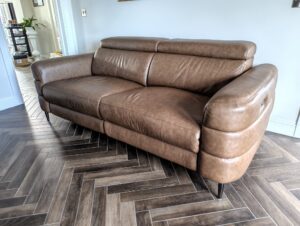
Photograph 1 – General view of the leather recliner sofa.
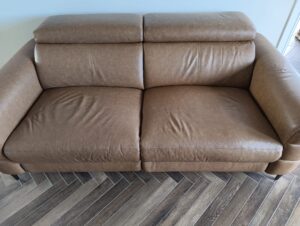
Photograph 2 – Frontal view showing the puddling and creasing across both seating positions.
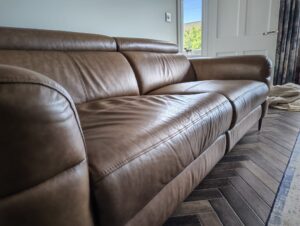
Photograph 3 – Side view of the fixed seating upholstery, showing the extent of the creasing.
FAULT 1: Inadequate support from the seat cushioning
Some degree of leather puddling/stretching is to be expected over the lifetime of upholstered furniture, particularly where softer, more supple leathers are used. Indeed, this sort of creasing might be commonplace in an older sofa which has seen a number of years of regular use, and I would not regard the mere presence of puddling as a manufacturing fault in its own right. However, the extent of the creasing here is certainly unusual for a sofa with fixed upholstery (as opposed to loose cushions), which is less than a year old at the time of my inspection.
More importantly, when I sat on both seating positions myself, I found that the seats dipped quite noticeably towards the outer arms and towards the centre of the sofa. In these areas I could feel the underlying wooden frame quite clearly through the cushioning, which in my opinion is an indication that the seating foam used is not providing sufficient support under normal sitting conditions.
I also examined the underside of the sofa, including its seating spring and webbing arrangement. These materials/components appeared to be in reasonable condition, with no obvious breakage or deficiency which might adequately explain the extent of the dipping I experienced. Whilst a visual inspection cannot rule out every possible suspension issue, the apparent condition of the springs and webbing leads me to strongly suspect that the primary cause lies with the foam used in the seat cushions themselves.
In my professional opinion, the foam grade used is either too soft to be suitable for its intended purpose, and/or the foam used is faulty – for example, through a manufacturing defect affecting the particular batch or its performance. Either would explain why the cushioning offers inadequate resistance to the weight of a person sitting on it, particularly at the edges of the seats, and why the leather above is subsequently left without sufficient support, gathering into the pronounced creasing shown in the photographs both before and after use.
It is difficult to determine from a physical inspection alone whether an unsuitable grade of foam was selected during manufacture, or whether an otherwise appropriate foam has failed to perform as intended. However, establishing which of these two possible causes is responsible is not necessary in order for me to assess the sofa’s condition at around ten months old.
What is clear to me is that the cushioning is not providing the support which I would reasonably expect of a sofa of this type and age. I therefore consider the seat cushioning to be defective and/or unsuitable for its intended purpose, most likely as a result of an inappropriate foam specification or a fault with the foam used during manufacture.
This is also why I disagree with the supplier’s previous assessment that the condition can be adequately explained by normal leather settlement alone. Whilst the leather has indeed puddled, I believe that this is predominantly a symptom of the inadequate support beneath it, rather than the puddling being the underlying fault itself. Simply smoothing or dressing the leather after use would do nothing to address the seating support issue which I experienced.
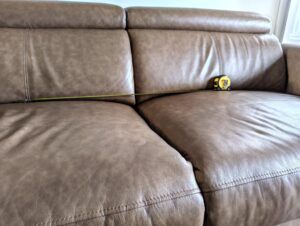
Photograph 4 – Close view of the seat/backrest areas, with the extended tape measure showing the extent of the ‘dipping’ of the seat cushions towards the centre.
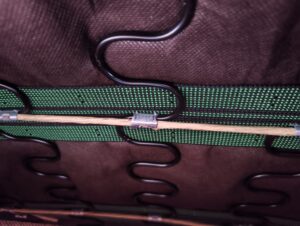
Photograph 5 of the underside, showing the seating spring and webbing arrangement;
FAULT 2: Misalignment of the top-stitched seams
I also noticed a discrepancy in the positioning of the top-stitched seams on the two adjacent seat cushions, at the point where they meet in the centre of the sofa. These seams are clearly intended to follow the same line across both seating positions, but there is a visible difference of approximately 6-7mm between them, as illustrated by the tape measure in the photographs below. To be clear, this was measured with both recliner seats in their fully upright positions.
Whilst it would be unreasonable to expect absolute precision in every adjoining seam on a piece of upholstered furniture – particularly when working with leather, which is a natural material – I consider this particular discrepancy to be slightly beyond what I would regard as a reasonable or satisfactory tolerance. The two seams sit immediately alongside one another, which makes the difference in their positioning quite noticeable.
In my opinion, this represents a relatively minor, but nonetheless identifiable, fault. It is a separate issue from the inadequate seat-cushioning discussed above. Obviously I cannot state whether this was present on delivery or when newly manufactured, but if not, it may itself have been caused by the defective seat-cushioning, as a result of the leather stretching out of shape, due to the inadequate support beneath it.
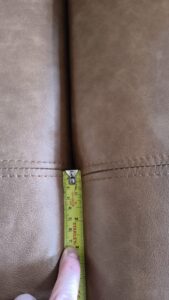
Photograph 6 – Tape measure illustrating the misalignment between the adjacent top-stitched seat seams.
CONCLUSION
Having physically inspected the sofa on 6th October 2026, I do not agree that the issues reported by the customer can be satisfactorily explained by normal settlement of the leather upholstery alone. Whilst some degree of puddling is to be expected over time, and I would not necessarily regard this as a fault in isolation, the more significant concern here is the inadequate support provided by both seat cushions.
When sitting on the sofa, I found that both seats dipped from the centre towards the outer arms and the centre, to the extent that I could clearly feel the underlying wooden frame. The springs and webbing visible beneath the seating areas appeared to be in reasonable condition, and I therefore strongly believe that the foam/padding is the most likely cause of the problem.
In my professional opinion, either the foam grade selected for this sofa is not providing enough support to be fit for its intended purpose, and/or the foam used is faulty as a result of a manufacturing defect. I cannot establish conclusively which of these possible causes applies, but this does not alter my conclusion that the cushioning is failing to provide a satisfactory level of support for a sofa which was less than a year old when inspected.
Additionally, I consider the approximately 6-7mm misalignment of the adjacent top-stitched seams to be slightly outwith what might be considered a reasonable manufacturing tolerance, and therefore a further, albeit less significant, fault either made during the manufacturing process, or as a result of the defective seat cushioning underneath the fixed leather upholstery.
Taken as a whole, I consider these issues to be inconsistent with the standard of manufacture and seating performance which ought reasonably to be expected of furniture of this type and age. In particular, I do not believe that attributing the appearance solely to normal settlement, adequately addresses the underlying deficiencies.
For these reasons, I do not consider the sofa, in its condition at the time of my inspection, to be of a satisfactory standard of quality or workmanship, particularly having regard to its age, and the normal seating performance which a customer ought reasonably to expect.
Please let me know whether you have any further questions or queries as regards this report. If you wish me to supply further statements (or assist in further proceedings), I’m only too happy to do so.
Yours Sincerely,
Signature Upholstery